




At the sea bass farming base in Baijiao Town, the morning is the busiest time of the day. Fishermen sort and load nets of lively sea bass into trucks, which are about to be transported to markets across China. Josaia Gonewai, Special Administrator of the Suva City Council in Fiji, stood by the pond listening to explanations while scribbling down notes. "I saw the great collaboration between the private sector and the farmers, which has increased productivity. This is what we can learn for our developing states with a great collaboration between entities."
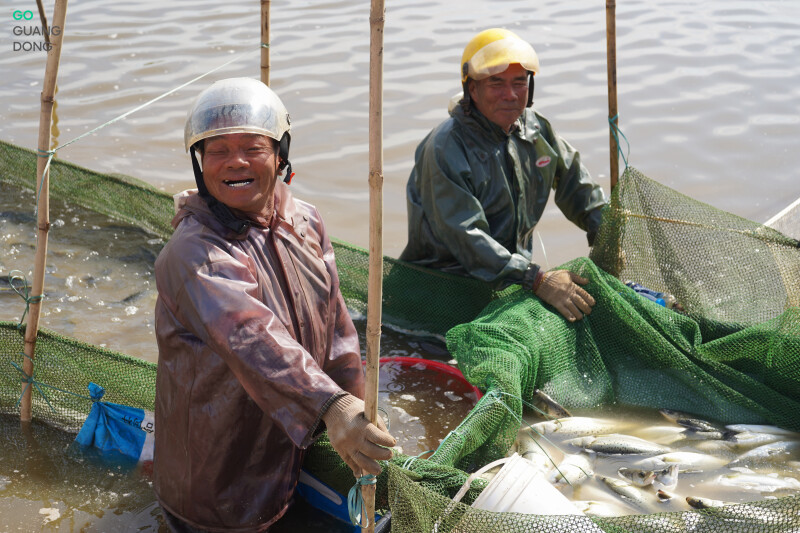
Fishermen during the harvest.
Prior to the 2025 Understanding China Conference (Guangzhou), a delegation consisting of foreign dignitaries from Sri Lanka, Iran, and Fiji, as well as media representatives from The Russian Television and Radio Broadcasting Company (RTR), South Korea's Aju Business Daily, and CCTV.com, embarked on the GO Guangdong Unseen Rural China Tour in Zhuhai and Jiangmen from November 28 to 30. In Baijiao Town, Doumen District of Zhuhai, the guests explored how the industry has helped drive local prosperity and rural revitalization.
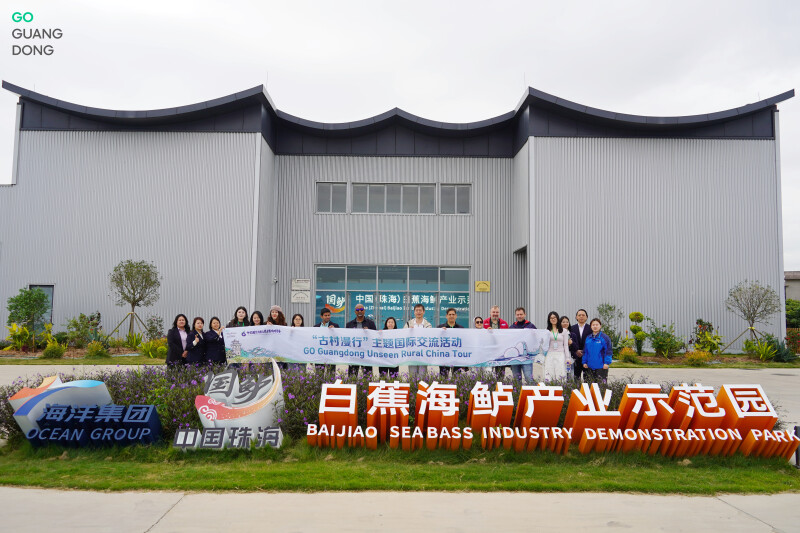
Doumen farmers started sea bass farming in the 1980s, a time when the local economy was still reliant on its sugar industry. Located at the estuary of the Pearl River, Doumen offers a favorable warm climate and brackish water environment for sea bass, allowing them to grow twice as fast as their wild counterparts and reach market size in just 10 months. In 2009, the Baijiao sea bass was designated as a nationally protected geographical indication product, and Baijiao Town was named the "Hometown of Chinese Sea Bass" the following year.
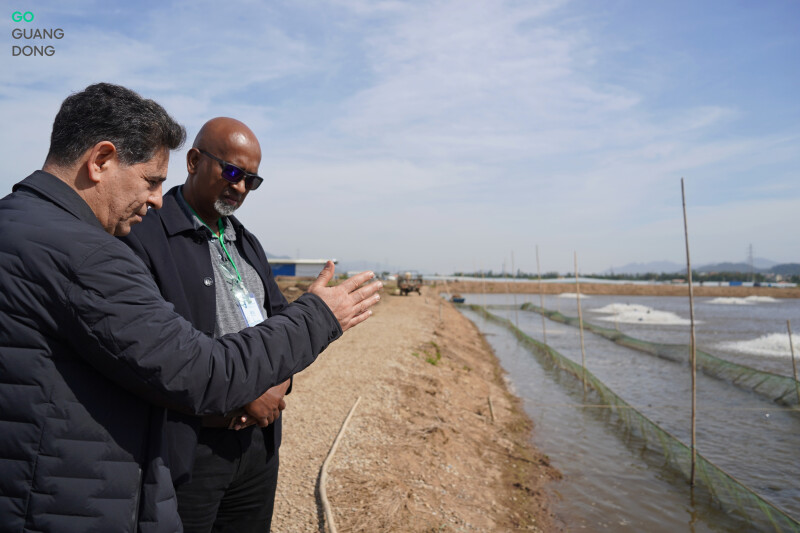
Reza Pirpiran, Counsellor of the Embassy of Iran in China, and Josaia Gonewai, Special Administrator of the Suva City Council in Fiji, were sharing ideas beside a fish pond.
At the fish pond, Reza Pirpiran, Counsellor of the Embassy of Iran in China, was busy taking photos and videos. He listened carefully about how the private sector works with fishermen, and shared insights with other visitors. Based on what he has learned, he noted that the rapid growth of the sea bass industry demonstrates how technology, supportive policies, and investments can work together to drive progress. He added that Iran, with its long coastline, could learn from such experience and looked forward to greater exchange and cooperation with China in fisheries.
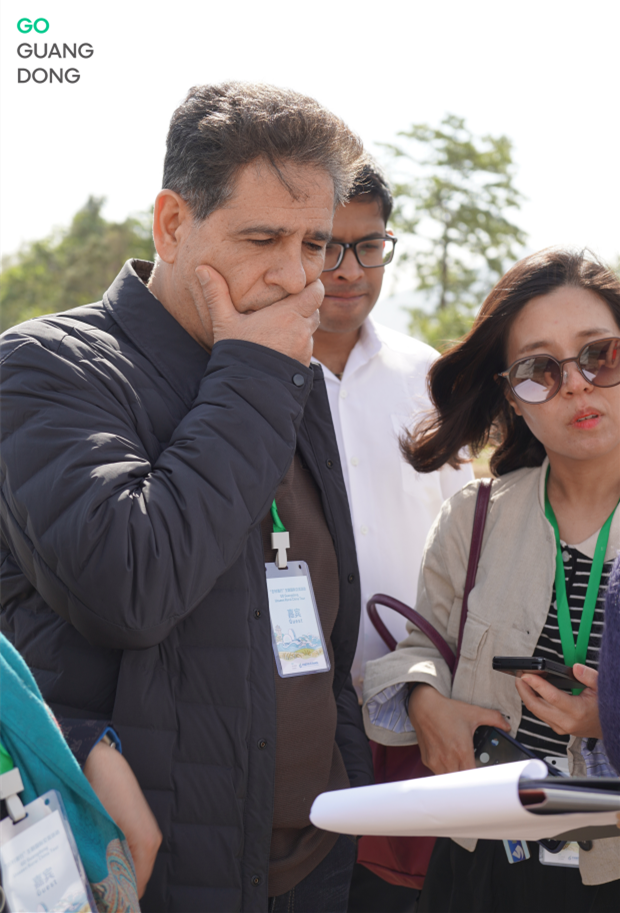
Visitors were listening attentively to explanations about the fish pond.
Alexander Balitskiy, Chief of RTR Bureau in China, was impressed by the scale of eco-agriculture in Guangdong, although he had visited the province a few times. “It's rather interesting to see that here in Guangdong, there are lots of ecological agriculture companies. It's really a great surprise for the world, because everybody considers Guangdong to be a province for manufacturing, not for agriculture. But you can see that Guangdong has a prosperous fish industry and rice industry as well,” he said. To capture the most vivid scenes, he waded into the water in borrowed fisherman’s gear to film the harvest and capture the lively footage for Russian audiences. “Lots of people should know the green development in Guangdong,” he remarked.
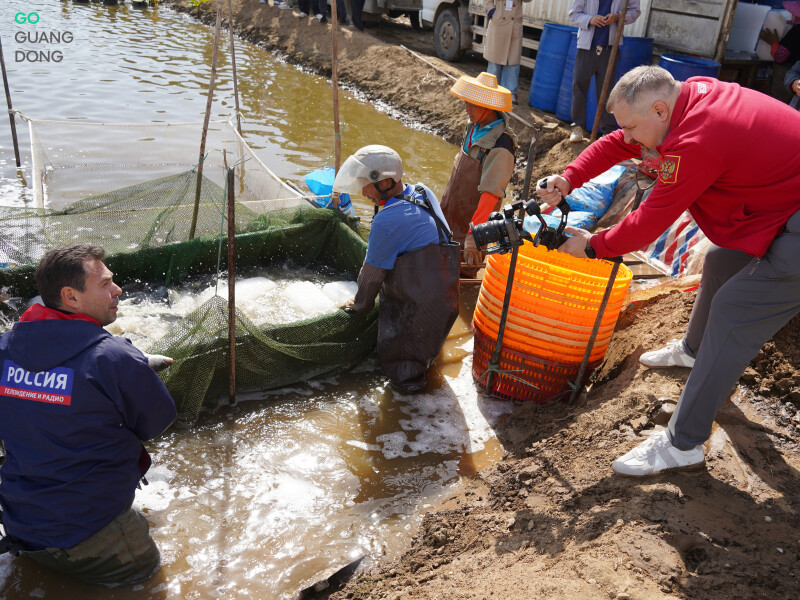
Alexander Balitskiy, Chief of RTR Bureau in China, was reporting in the pond.
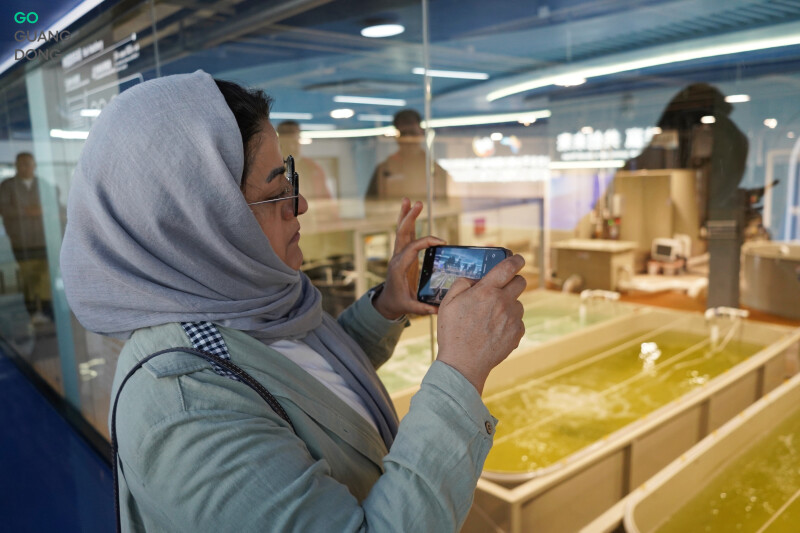
Shirin Pirpiran, wife of Reza Pirpiran, was taking photos in front of the fry breeding workshop at the Chinese (Zhuhai) Baijiao Sea Bass Industrial Demonstration Park.

In February this year, the first batch of 3 million high-quality, locally bred sea bass fry was delivered in Baijiao, marking a historic breakthrough. Inside the left glass beaker are Baijiao sea bass fish eggs.
Reporter: Ding Hefei, Zhou Hongdou, Yin Juewen
Video: Luo Yuan, Li Jiangrui
Photo: Ding Hefei
Proofreader: Lai Yuqing